It’s about allowing as much as doing
We’ve all fallen in and out of love with our work: Sometimes multiple times over the course of a project. As a creative and human, I love love: the idea of it, the feeling of it, its transformational nature, its changing texture as it grows and evolves.
But we, as humans, also have a complex relationship to love as a concept (look at all our social norms around romantic relationships), AND we have a complex relationship to work (hello, grind culture). And so “falling in love with your work” can be a big ask and a tricky proposition.
I adore the book I’m writing right now: I can see specific ways it’s going to benefit my readers, and specific ways it adds to our knowledge in ways I find very exciting.
But, even with a project I love so much, sometimes the motivation isn’t there, or it feels like a slog. Writing, like any kind of love, is not all love and light all the time: Some days really are hard. And so how do we stay connected to the love of our work in a way that will see us through those moments?
Becoming enchanted with writing
Rather than thinking of love for our work conceptually or analytically, what if you connected to the embodied and emotional feeling of love? What if your love of your writing rested not in your thinking mind but your feeling body and soul?
Think of the feeling of being in love and being loved (romantically or otherwise), or of experiencing something so wonderful that it sparks your excitement in an almost giddy sort of way. How does that feel in your body (and where do you notice sensation?)
How does it feel emotionally?
I’d describe my feelings as “sparkly,” but also expansive, eager for more, trusting, optimistic, tingly, receptive, delighted.
Enchanted.
In other words, rather than insisting that you be in love with your work all the time, think about the actual physical and emotional feelings that love elicits.
Let the tide of your emotions shift and roll, as they will, but continue holding on to that good feeling that keeps you hungry to connect to the object of your attention, that keeps you curious, excited, receptive. And on days when things aren’t feeling good, the fact that you’ve cultivated love and enchantment, woven into the fabric of your writing life, means the opportunity is there to reconnect with them.
That gives you a chance to turn towards the thing you desire and to recalibrate yourself even on days when you are feeling decidedly not in love with work or life.
That’s enchantment.
Letting yourself feel enchanted by your writing, rather than your writing demanding a certain emotional payment, lets you and your writing co-exist in a more human, realistic way.
And enchantment implies a sort of mutually-created magic between you and your ideas: One that’s dazzling, surprising, delightful, and one that lets you step into the fullness of your work. Because when you’re feeling enchanted, you’re eager to keep walking down that path and experience more of it, right?
When we allow our work to enchant us, we trust our ideas and our inner wisdom to cast a spell on us: We are willing to follow and listen, and let ourselves just trust and enjoy the process. Like wandering into a forest in a fairytale, but in our story, only wonderful things wait within.
Here’s how I weave enchantment into my writing practice:
Cultivating an enchanted life is as much about allowing enchantment in as it is actively doing anything.
Allowing:
Turn your attention to what’s already incredible in your life, what’s working well in your writing, what makes you feel good.
We are often resistant to fully allowing and trusting good feelings, even/especially with our creative work: And yes, there are many reasons we’re slow to trust (which go beyond the scope of a newsletter) BUT when it comes to your creative intuition, that’s one thing you can trust 100%.
Allowing has another dimension too, which is expansion: in other words, appreciating all the great stuff that’s already happening, and allowing yourself to imagine it getting even better and greater and more amazing. The more you imagine that incredible future, the more liable you are to let it in. That’s true for your writing, and for life in general.
To cultivate enchantment, make this less about facts and figures (“I want to sell 10,000 copies of my book”) and more about feelings: What feels really good, expansive, tingly, and so on, in your nervous system and your spirit? What lights you up, even if from a logical standpoint it doesn’t make sense?
Opening the possibility for serendipity:
Creating an enchanted writing life means creating space for enchantment to happen.
Allowing serendipity in is one of my favorite ways to do this: Building in space for pleasant, unexpected surprises to happen (think short nature walks, time in the garden, time daydreaming or trying something fun and new, whether going to a new coffee shop or reading a new poetry chapbook).
I try to have one new experience every day, and to actively let myself feel appreciation for it.
How do you cultivate serendipity?
Holding space:
I create a physical space I enjoy, that includes things that have sparked a feeling of enchantment for me in the past:
On or near my desk right now, for example, are a James Baldwin saint candle, a tapestry I bought at a roadside stand in Turkey, my grandma’s pencil jar, and a piece of quartz I picked up while doing a walking meditation in the woods.
Each reminds me of a specific moment in my creative life that anchors me to the internal resonance of love and enchantment. Or it anchors me in the feeling of excitement for where I’m headed on my creative path, and where I’ve been, which helps me experience enchantment in a different way.
How do you re-enchant your writing life?
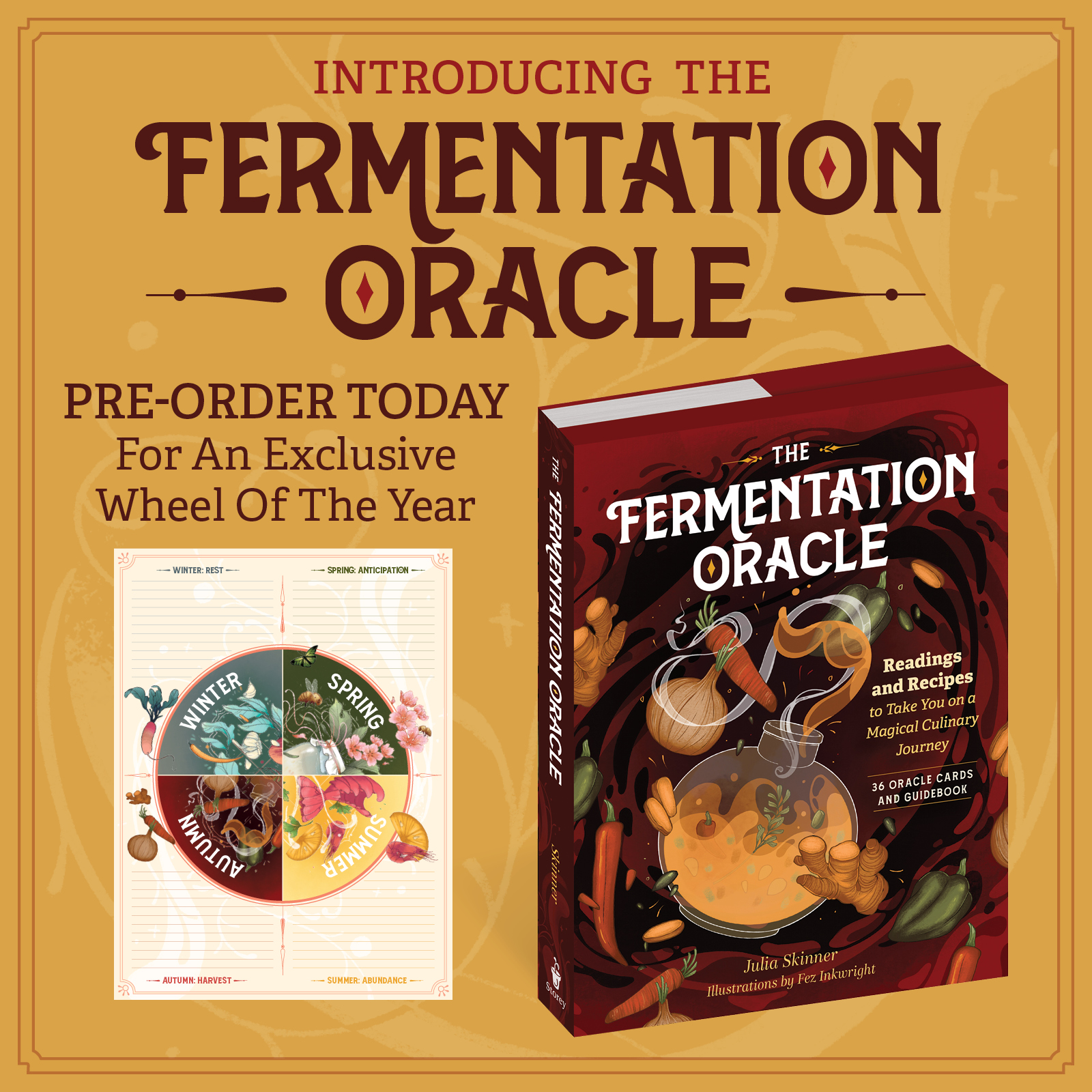
Speaking of enchantment, my next book, The Fermentation Oracle, is available for preorder!
When you use the code MAGIC20 on Hachette’s site, you get 20% off your deck.
AND, the folks at Storey and I made you a very cool present:
The first 100 people to preorder and fill out this form get a very special fermentation wheel of the year mailed to their door.
I’m so excited about and proud of this, and am especially excited to hear how the book and the wheel both serve your creative culinary practice in the years to come!
 Roots and Branches
Leave a comment